
Not All Frames Deserve Full Computation: Accelerating Autoregressive Video Generation via Selective Computation and Predictive Extrapolation
Edge Intelligence Systems Lab; Shenzhen University of Advanced Technology
自回归视频生成的加速:在“缓存”和“重算”之间加入“预测”,并且只计算当前活跃的帧区间。在 MAGI-1 和 SkyReels-V2 上最高加速 4.73 倍。
简介
自回归视频扩散模型能生成长视频,但每一段都要多步去噪,代价很高。现有的免训练加速方法只在“直接复用缓存”和“完整重新计算”之间二选一,忽略了中间情况:直接复用太粗糙,完整重算又没必要。此外,异步的自回归调度会给同时生成的各帧分配不同的噪声水平,而现有方法对整个有效区间一视同仁。
针对这些问题,SCOPE 提出缓存、预测、重算三种模式的调度器,其中“预测”通过在噪声水平上做泰勒外推来填补复用与重算之间的空白,并配有基于误差传播分析的稳定性控制;同时引入选择性计算,只在活跃帧区间上执行模型。在 MAGI-1 和 SkyReels-V2 上,SCOPE 最高加速 4.73 倍,画质与原输出相当,优于所有免训练的对比方法。
方法
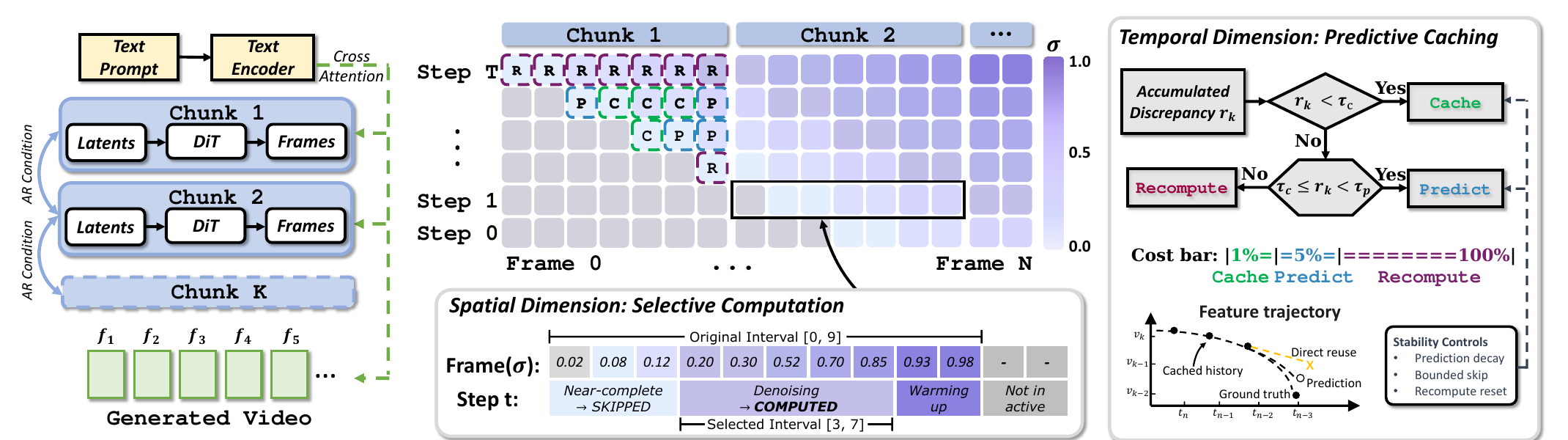
Abstract(英文摘要)
Autoregressive (AR) video diffusion models enable long-form video generation but remain expensive due to repeated multi-step denoising. Existing training-free acceleration methods rely on binary cache-or-recompute decisions, overlooking intermediate cases where direct reuse is too coarse yet full recomputation is unnecessary. Moreover, asynchronous AR schedules assign different noise levels to co-generated frames, yet existing methods process the entire valid interval uniformly. To address these AR-specific inefficiencies, we present SCOPE, a training-free framework for efficient AR video diffusion. SCOPE introduces a tri-modal scheduler over cache, predict, and recompute, where prediction via noise-level Taylor extrapolation fills the gap between reuse and recomputation with explicit stability controls backed by error propagation analysis. It further introduces selective computation that restricts execution to the active frame interval. On MAGI-1 and SkyReels-V2, SCOPE achieves up to 4.73x speedup while maintaining quality comparable to the original output, outperforming all training-free baselines.
引用
@inproceedings{cui2026scope,
  title     = {Not All Frames Deserve Full Computation: Accelerating Autoregressive Video Generation via Selective Computation and Predictive Extrapolation},
  author    = {Cui, Hanshuai and Tang, Zhiqing and Yao, Zhi and Meng, Fanshuai and Jia, Weijia and Zhao, Wei},
  booktitle = {Proceedings of the ACM International Conference on Multimedia (ACM MM)},
  year      = {2026}
}