
Predict to Skip: Linear Multistep Feature Forecasting for Efficient Diffusion Transformers
Edge Intelligence Systems Lab; Shenzhen University of Advanced Technology
Instead of naively reusing features, PrediT forecasts future denoising outputs with linear multistep methods, corrects in high-dynamics regions, and adapts how many steps to skip. Up to 5.54× faster.
Method
Abstract
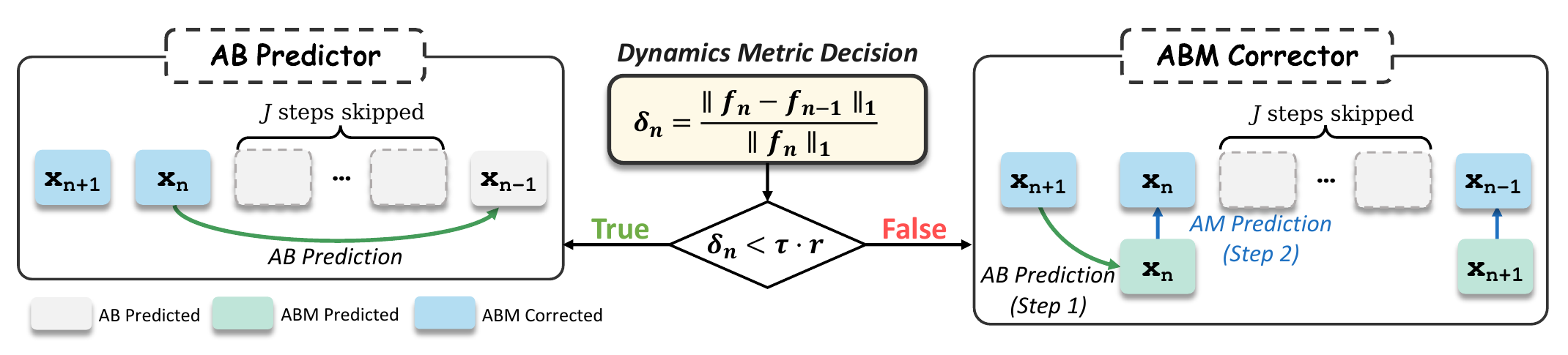
Diffusion Transformers (DiT) have emerged as a widely adopted backbone for high-fidelity image and video generation, yet their iterative denoising process incurs high computational costs. Existing training-free acceleration methods rely on feature caching and reuse under the assumption of temporal stability. However, reusing features for multiple steps may lead to latent drift and visual degradation. As recognized in recent work, model outputs evolve smoothly along much of the diffusion trajectory. We leverage this property to enable principled predictions rather than naive reuse. Based on this insight, we propose PrediT, a training-free acceleration framework that formulates feature prediction as a linear multistep problem. We employ classical linear multistep methods to forecast future model outputs from historical information, combined with a corrector that activates in high-dynamics regions to prevent error accumulation. A dynamic step modulation mechanism adaptively adjusts the prediction horizon by monitoring the feature change rate. Together, these components enable substantial acceleration while preserving generation fidelity. Extensive experiments validate that our method achieves up to 5.54x latency reduction across various DiT-based image and video generation models, while incurring negligible quality degradation.
Citation
@inproceedings{cui2026predit,
  title     = {Predict to Skip: Linear Multistep Feature Forecasting for Efficient Diffusion Transformers},
  author    = {Cui, Hanshuai and Tang, Zhiqing and Ma, Qianli and Yao, Zhi and Jia, Weijia and Zhao, Wei},
  booktitle = {Proceedings of the ACM International Conference on Multimedia (ACM MM)},
  year      = {2026}
}
More projects
DiT block features barely change during intermediate denoising steps. BWCache caches and reuses them block by block, giving up to 2.6× speedup with comparable visual quality and no training.
SCOPEACM MM 2026For autoregressive video diffusion, SCOPE adds a predict mode between cache and recompute, and only computes the active frame interval. Up to 4.73× faster on MAGI-1 and SkyReels-V2.